 listicle
Healthcare IT Solutions for Ophthalmology Practices
Table of Contents
- Healthcare IT Solutions for Ophthalmology Practices: Feature Comparison
- 1. Nextech: Best-in-KLAS Specialty-Focused EHR
- 2. ModMed EMA: AI-Powered Mobile Documentation
- 3. RevolutionEHR: Cloud-Native Eye Care Platform
- 4. Compulink: Customizable Optical Lab Integration
- HIPAA Compliance for Ophthalmology Practices
- Cybersecurity for Medical Practices and Patient Data Protection
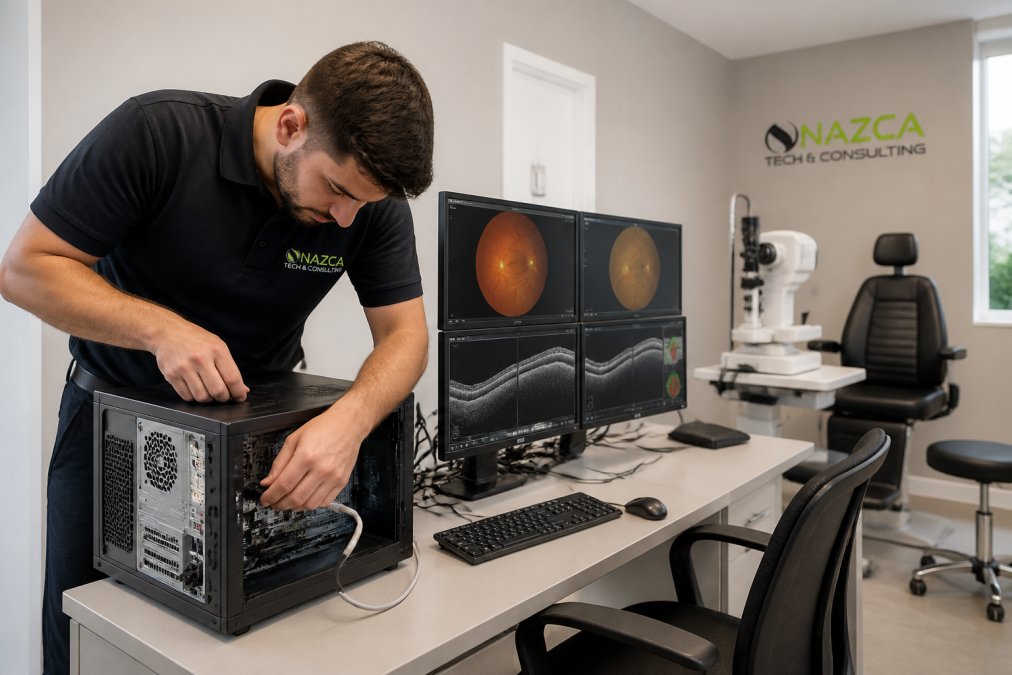
- Managed IT Services for Eye Care Clinics
- Frequently Asked Questions
Last Updated: September 26, 2026
Healthcare IT Solutions for Ophthalmology Practices: Feature Comparison
The ophthalmology EHR market is projected to grow from $48.15 billion in 2026 to $88.53 billion by 2034, according to Straits Research market analysis. That explosive growth reflects a hard truth: practices that don't modernize their IT infrastructure fall behind on efficiency, compliance, and patient outcomes. The challenge isn't finding solutions, it's finding the right one for your specific workflow.
This guide compares leading healthcare IT solutions for ophthalmology practices, showing how to evaluate platforms against your practice's needs. The solutions covered have generated measurable improvements in operational efficiency and regulatory compliance.
Quick Picks:
- Best Overall: Nextech, specialty-focused EHR with proven KLAS recognition for ambulatory ophthalmology
- Best for Mobile Workflows: ModMed EMA, AI-powered documentation reduces charting time significantly
- Best for Cloud-Native Operations: RevolutionEHR, fully web-based, no server maintenance required
- Best for Customization: Compulink, deep optical lab integration and workflow flexibility
| Solution | Architecture | Best For | Key Strength |
|---|---|---|---|
| Nextech | On-premise/Cloud hybrid | High-volume practices | Specialty-specific templates |
| ModMed EMA | iPad-native cloud | Mobile-first teams | AI documentation assistance |
| RevolutionEHR | Fully cloud-based | Paperless operations | Browser-based, no IT overhead |
| Compulink | Customizable hybrid | Large clinics | Optical lab integration |
1. Nextech: Best-in-KLAS Specialty-Focused EHR
Nextech earned recognition in the KLAS Research Best in KLAS rankings for ambulatory ophthalmology solutions, a distinction that reflects how well the platform handles real-world eye care workflows. This isn't a generic medical EHR adapted for ophthalmology, it's built from the ground up for your specialty.
Specialty-specific templates capture visual acuity, intraocular pressure, visual field results, and OCT imaging. The integrated billing module reduces claim denials through automated payer-specific coding, and analytics provide real-time visibility into clinical outcomes and revenue cycle performance.
Strengths: High-volume throughput gains, complex imaging workflows, straightforward EHR integration. Limitations: 4-6 month implementation, steep learning curve, customization requires consulting services.

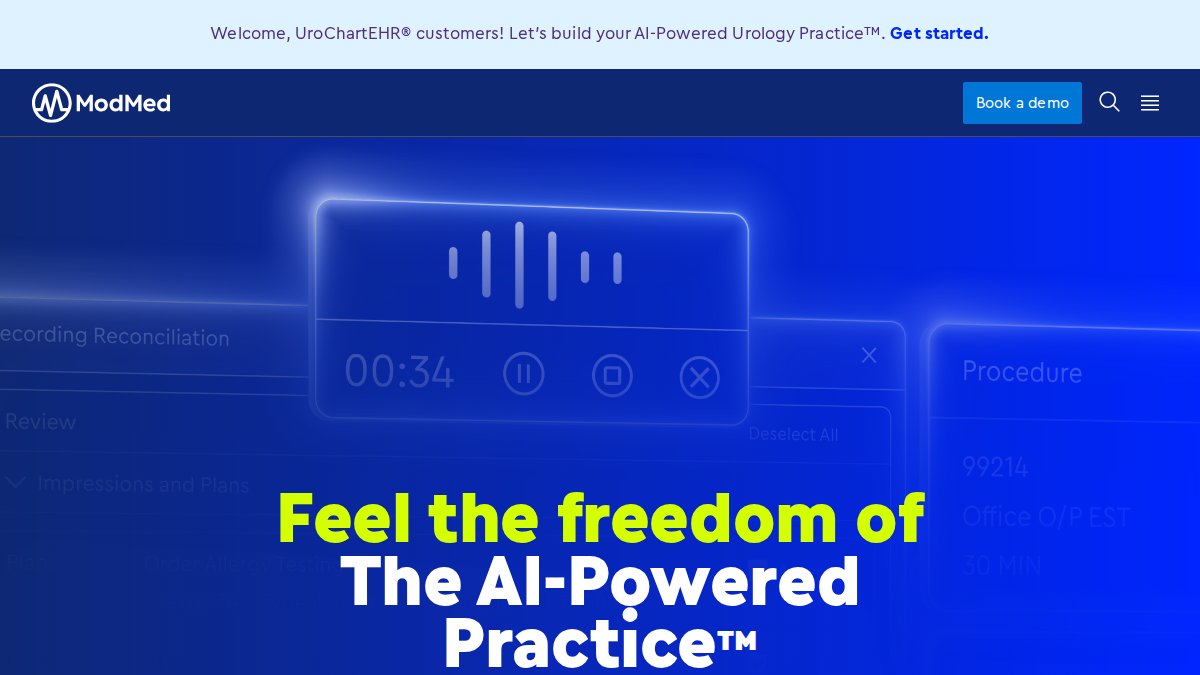
2. ModMed EMA: AI-Powered Mobile Documentation
ModMed EMA uses iPad-based dictation and handwriting with AI that learns your documentation patterns, auto-populating fields and suggesting completeness checks.
The platform's artificial intelligence-driven clinical decision support system (AI-CDSS) integration is complex and context-specific, as research from BMC Health Services Research on AI integration in ophthalmology has shown. That complexity pays off: providers report 30-40% faster charting compared to traditional EHR workflows. MIPS reporting is built in, so you're capture-ready for Merit-based Incentive Payment System quality measures without manual extraction.
The iPad-native interface eliminates desktop workstations in exam rooms, and included patient portal access reduces administrative burden.
Strengths: Faster charting, intuitive interface, solid optical device integration. Limitations: Apple-only hardware, custom development needed for non-standard equipment, slow support for complex integrations.
3. RevolutionEHR: Cloud-Native Eye Care Platform
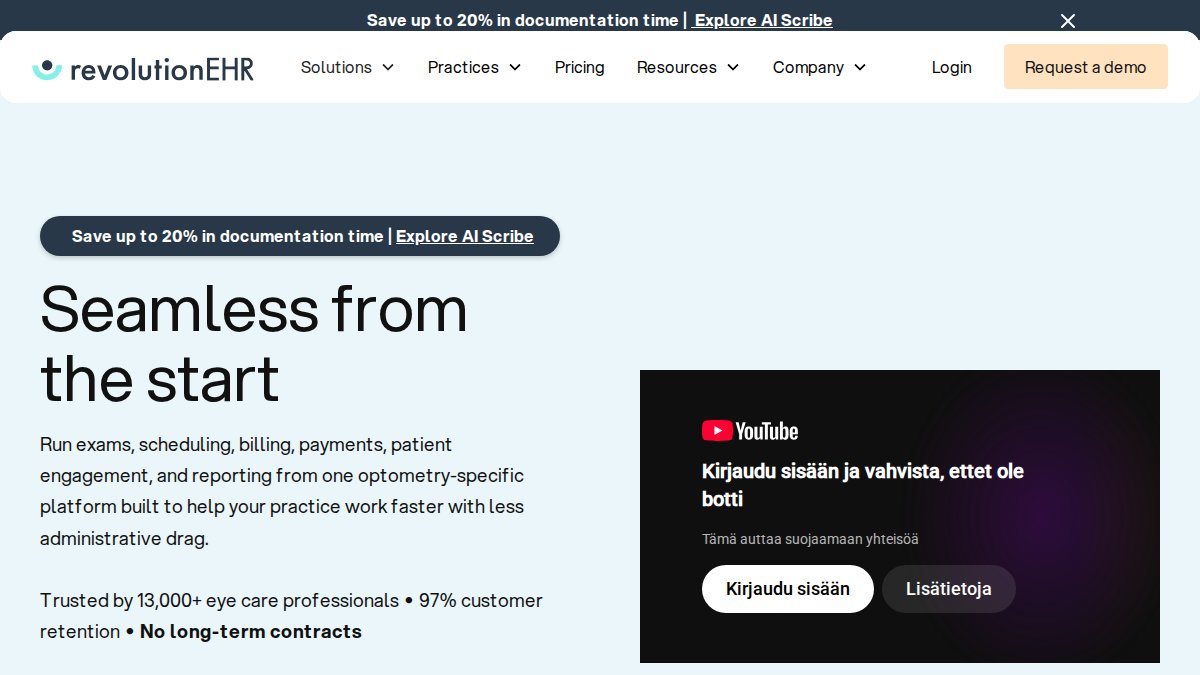
RevolutionEHR is fully web-based with zero on-premise servers, eliminating IT hardware management.
Built for eye care, it includes native optical inventory management with automated reorder triggers, integrated scheduling, and automatic insurance eligibility verification.
Strengths: No server maintenance, browser-based on any device, built-in scalability. Limitations: Requires consistent high-speed internet, offline access unavailable, performance depends on connection quality, limited older equipment integration.
4. Compulink: Customizable Optical Lab Integration
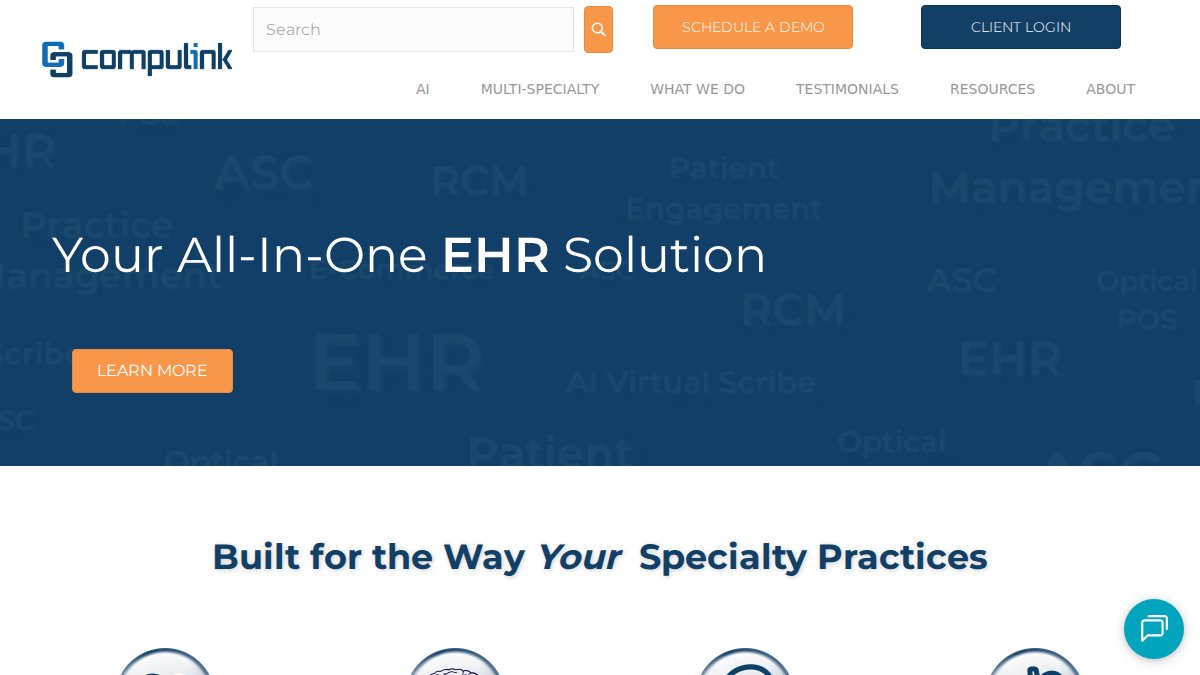
Compulink targets practices needing deep customization, especially those with in-house optical labs or multi-location operations, with a workflow engine for practice-specific automation.
Extensive specialty templates with deep customization for dashboards, alerts, and workflow logic. Standout optical lab integration includes frame inventory, lens manufacturing, order tracking, and lab-to-patient delivery with granular profitability analytics.
Strengths: Unmatched customization depth, strong multi-location support. Limitations: Steep learning curve, requires dedicated IT resources, 6-12 month implementation, variable support responsiveness.
HIPAA Compliance for Ophthalmology Practices
HIPAA compliance for ophthalmology practices requires specialized handling of diagnostic imaging data, OCT scans, fundus photographs, visual field plots, and corneal topography maps, beyond typical clinical documentation.
Diagnostic imaging devices often operate on separate networks from your EHR, transmitting via DICOM protocol. Each connection point is a potential compliance vulnerability.
DICOM and Imaging Device Integration Compliance
DICOM is the standard protocol for medical imaging but predates modern cybersecurity. Under HIPAA's Technical Safeguards rule (45 CFR § 164.312), all ePHI transmission must be encrypted in transit:
- Your DICOM network must use TLS (Transport Layer Security) encryption, not legacy unencrypted DICOM connections
- Imaging devices must authenticate to your EHR before transmitting data (not just accept any connection)
- Image storage must use AES-256 encryption at rest, whether on the device, imaging server, or EHR database
- Access logs must track which staff members accessed which patient images, with timestamps and audit trails
Older diagnostic equipment may not support encrypted DICOM.
Administrative Safeguards Specific to Imaging Workflows
Backup and Disaster Recovery for Imaging Data
Compliance Checkpoints for Ophthalmology Practices
Cybersecurity for Medical Practices and Patient Data Protection
Ophthalmology-Specific Threat Vectors
Technical Controls for Ophthalmology IT Infrastructure
Technical controls include: network segmentation for imaging devices, EDR monitoring for suspicious activity, MFA for imaging access, TLS 1.2+ encrypted DICOM, formal firmware management, AES-256 encrypted air-gapped backups, and comprehensive audit logging of all imaging access.
Ransomware Response for Imaging Systems
Threat Intelligence and Vulnerability Management
Measuring Cybersecurity Effectiveness
- Mean time to detect (MTTD): How quickly do you identify a security incident? Target: less than 24 hours.
- Mean time to respond (MTTR): How quickly do you contain and remediate an incident? Target: less than 4 hours for critical imaging system incidents.
- Vulnerability remediation rate: What percentage of identified vulnerabilities are patched within 30 days? Target: 95%+.
- Incident frequency: How many security incidents occur per year? Track trends, a declining incident rate indicates effective security controls.
- Backup recovery success rate: What percentage of backup restoration tests succeed without data loss? Target: 100%.
Managed IT Services for Eye Care Clinics
| Support Type | Response Time | Best For | Cost Model |
|---|---|---|---|
| Break-fix | 4-24 hours | Small practices with minimal downtime risk | Per-incident billing |
| Managed IT | 1-3 hours | Practices requiring operational continuity | Monthly retainer |
| Hybrid (on-site + remote) | 1 hour remote / 3 hours on-site | Multi-location practices with complex infrastructure | Tiered retainer |
The Bottom Line
Frequently Asked Questions
What are the HIPAA compliance requirements for healthcare IT solutions in ophthalmology?
Ophthalmology practices must ensure their healthcare IT solutions encrypt patient eye health data both in transit and at rest, maintain detailed audit logs of all data access, implement role-based access controls, and conduct regular security risk assessments. The Health Insurance Portability and Accountability Act (HIPAA) requires covered entities to safeguard electronic protected health information (ePHI). For ophthalmology specifically, this includes patient vision records, diagnostic imaging, and treatment histories. A qualified IT provider trained in HIPAA compliance can help configure your EHR and practice management systems to meet these federal standards and avoid costly violations.
How do cloud-based EHR systems benefit ophthalmology practices?
Cloud-based EHR systems eliminate the need for on-site server maintenance, reduce capital infrastructure costs, enable secure remote access for providers, and scale automatically as your practice grows. Ophthalmology practices benefit from reduced downtime since cloud providers maintain 99.9% uptime guarantees, automatic software updates without disrupting workflows, and seamless integration with diagnostic imaging devices. Cloud architecture also simplifies data backup and disaster recovery, ensuring patient records remain accessible even during emergencies. This approach allows smaller practices to access enterprise-grade technology without the overhead of managing complex IT infrastructure.
What cybersecurity measures are essential for protecting patient eye health data in medical practices?
Essential cybersecurity measures include multi-factor authentication for all system access, encryption of all patient data, regular security awareness training for staff, automated threat detection and response systems, and regular penetration testing. Ophthalmology practices should also implement network segmentation to isolate clinical systems from general office networks, maintain firewalls configured specifically for healthcare environments, and establish incident response procedures. Managed IT services providers specializing in healthcare can monitor your systems 24/7 for suspicious activity, apply security patches immediately, and conduct compliance audits to ensure your practice meets HIPAA and state-level data protection requirements.
How can managed IT services improve ophthalmology practice efficiency?
Managed IT services for eye care clinics provide proactive monitoring that prevents system failures before they impact patient care, rapid response times (1-hour remote support and 3-hour on-site emergency response), and strategic technology planning aligned with your practice goals. Instead of reactive break-fix support, managed services optimize your EHR workflows, ensure seamless integration between practice management and clinical systems, and handle routine maintenance like software updates and security patches. This approach reduces unplanned downtime, improves staff productivity by eliminating technology frustrations, and allows your team to focus on patient care rather than IT troubleshooting.
Why is interoperability important in healthcare IT solutions for ophthalmology?
Interoperability allows your EHR, practice management system, diagnostic imaging devices, and billing software to communicate seamlessly, eliminating manual data entry and reducing errors. In ophthalmology, this means diagnostic data from optical coherence tomography (OCT) scanners, visual field tests, and refraction equipment flows directly into patient records. Interoperable systems reduce administrative overhead, improve care coordination when patients see multiple specialists, and provide a single source of truth for patient data. When selecting healthcare IT solutions, verify that your chosen platform supports industry-standard interfaces like HL7 and FHIR, and confirm that your IT provider can manage integration with your existing diagnostic equipment and third-party applications.