 listicle
IT Consulting for Medical Clinics: 8 Top Providers
Table of Contents
- Why IT Consulting Matters for Medical Clinics
- Quick Comparison of Top IT Consulting Providers
- Nazca Tech: 21 Years of HIPAA-Compliant Infrastructure
- COBAIT Healthcare: All-Inclusive Managed IT Services
- HoustonTech: 24/7 Support with EHR Integration
- TrueNorth ITG, CNiC Solutions, Expert Computer Solutions, and ReMedi Health
- HIPAA Compliant IT Support for Medical Offices
- Healthcare Cybersecurity Best Practices for Your Clinic
- How to Choose the Right IT Consulting Partner
- Frequently Asked Questions
Last Updated: September 2, 2026
Why IT Consulting Matters for Medical Clinics
IT consulting for Houston medical clinics has become non-negotiable. A single data breach exposes patient records, tanks reputation, and triggers regulatory penalties. Yet most clinics operate with fragmented systems, outdated security, and IT staff stretched too thin to handle modern threats.
According to the Office of the National Coordinator for Health Information Technology, 91% of office-based physicians and over 99% of non-federal acute care hospitals adopted certified EHRs as of 2024. However, a study of 1,026 U.S. hospital systems found that only 15.8% achieved digital maturity needed for coordinated patient care. The right IT consulting partner doesn't just fix broken servers, they architect your entire technology foundation around HIPAA compliance, cybersecurity, and operational efficiency. At Nazca Tech, we've spent over 21 years helping medical practices eliminate anxiety around patient data security while freeing clinicians to focus on care.
Quick Comparison of Top IT Consulting Providers
| Provider | Key Strength | Best For | Response Time |
|---|---|---|---|
| Nazca Tech | 21+ years, HIPAA-trained technicians, hybrid support model | Multi-location practices, custom software needs | 1 hour remote / 3 hours on-site |
| COBAIT Healthcare | All-inclusive managed services, strong compliance focus | Clinics needing comprehensive IT overhaul | 24/7 helpdesk |
| HoustonTech | EHR integration expertise, affordable predictable pricing | Practices using eClinicalWorks, Athenahealth, Epic | 24/7 helpdesk + on-site |
| TrueNorth ITG | Tiered service model, strategic vCIO services | Practices wanting scalable, flexible solutions | 24/7 remote support |
| CNiC Solutions | Deep HIPAA compliance, dedicated cybersecurity | Practices with complex security requirements | 24/7 helpdesk |
| Expert Computer Solutions | 20+ years healthcare IT experience, free consultation | Multi-location clinics, surgical centers | 24/7 monitoring |
| ReMedi Health Solutions | Physician-led EHR implementation, peer-to-peer training | Practices optimizing clinical workflows | Project-based |
| Center for Quality Healthcare IT | Academic-backed consulting, security risk analysis | Practices needing compliance audits, MIPS reporting | Consultation-based |
Nazca Tech: 21 Years of HIPAA-Compliant Infrastructure
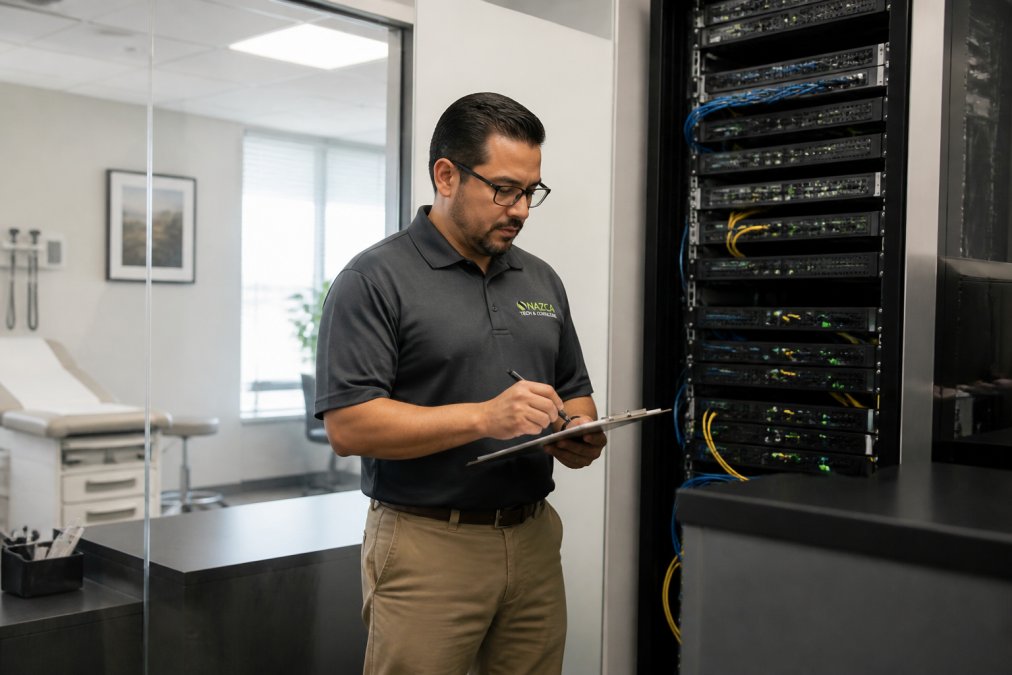
Nazca Tech embeds HIPAA compliance into every decision rather than treating it as a checkbox. With over 21 years of healthcare IT expertise, their team delivers rapid response capability that small-to-medium clinics need: 1-hour remote response and 3-hour on-site emergency response for critical failures.
Their technicians are trained in HIPAA compliance and ePHI security protocols, understanding the regulatory weight of every decision. Their custom software development capability addresses legacy workflows that off-the-shelf EHR systems don't accommodate. They handle cloud hosting, data backup, disaster recovery, and vendor management as an integrated package.
They scale with you, whether you're a single-location practice or a multi-clinic network, without forcing unnecessary enterprise packages.
COBAIT Healthcare: All-Inclusive Managed IT Services
COBAIT Healthcare bundles everything into one comprehensive package: advanced security protocols, 24/7 helpdesk support, proactive monitoring, data backup and disaster recovery, and cloud solutions. One contract, one bill, one point of accountability appeals to clinics tired of juggling multiple vendors.
Their strength lies in systematic HIPAA compliance. They audit your entire environment, identify gaps, and implement controls that survive regulatory scrutiny. This methodical approach works best for practices preparing for audits or recovering from compliance gaps.
HoustonTech: 24/7 Support with EHR Integration
HoustonTech specializes in major EHR systems like eClinicalWorks, Athenahealth, and Epic. Their 24/7 helpdesk includes actual EHR expertise, not generic IT support. They handle endpoint security, HIPAA-compliant data storage, proactive monitoring, and disaster recovery while understanding clinical workflows.
Their pricing emphasizes predictability with fixed monthly costs rather than surprise bills. The limitation: phone support is Monday to Friday, 7:30 AM to 7:00 PM, though 24/7 helpdesk ticketing is available.

TrueNorth ITG, CNiC Solutions, Expert Computer Solutions, and ReMedi Health
TrueNorth ITG offers three tiered levels of managed healthcare IT services designed to match your budget and complexity. They offer vCIO services for strategic IT planning.
CNiC Solutions emphasizes deep HIPAA compliance and dedicated cybersecurity with structured risk assessments, endpoint protection, and real-time threat detection. Best suited for practices with complex IT environments or those recovering from security incidents.
Expert Computer Solutions brings over 19 years of healthcare IT experience with 24/7 monitoring, business continuity and disaster recovery, and virtual CIO services. They offer a free IT consultation to assess your current environment. telehealth data security.
ReMedi Health Solutions specializes in physician-led EHR implementation and training. If you're switching EHR systems or optimizing workflows, their peer-to-peer approach drives adoption better than generic IT training.
HIPAA Compliant IT Support for Medical Offices
HIPAA compliance is an operating model, not a one-time project. Technical safeguards require encryption, access controls, audit logging, and backup procedures. Compliance also demands documentation, staff training, and regular risk assessment.
Data encryption must protect patient information in transit and at rest across email, cloud storage, backup infrastructure, and network traffic. Access controls require role-based permissions, a front-desk scheduler shouldn't access clinical notes. HIPAA requires audit logging of who accessed what and when, plus procedures to revoke access when staff leave.
According to HealthIT data from 2025, 99% of hospitals offered patients electronic access to their records, creating new security requirements for patient portals.
Documentation is critical. HIPAA requires written policies for data handling, breach response, staff training, and business continuity. Regulators ask "Show me your written encryption policy," not just "Are you encrypted?" After conducting a HIPAA Technical Safeguard gap assessment, centralizing endpoint management, deploying audit logging, and implementing encrypted data transmission policies, practices can achieve consistent security across all locations.
Healthcare Cybersecurity Best Practices for Your Clinic
Ransomware attacks on medical practices have doubled in recent recent years. Attackers know clinics will pay to restore patient access.
Start with strong passwords and multi-factor authentication on every account touching patient data. MFA stops 99% of credential-based attacks.
Network segmentation prevents lateral movement. If your front-desk computer gets infected, it shouldn't access clinical systems. Separate networks for clinical data, administrative systems, and guest Wi-Fi create barriers.
Offline backups protect against ransomware. Systems disconnected from your network can't be encrypted by malware. Test recovery procedures quarterly, many practices discover corrupted backups only when they need them.
Staff training prevents most breaches. Phishing emails trick clinicians into clicking malicious links. Regular security training, phishing simulations, and clear incident reporting create a culture where staff recognizes threats.
Vendor management matters. Ask EHR vendors, billing services, and telehealth platforms about security practices, certifications, and breach history. Include security requirements in contracts.
The U.S. healthcare IT market is projected to reach $566.48 billion by 2034, growing at 13.44% CAGR. That growth means more complexity and more attack surface. Practices treating cybersecurity as strategic priority will thrive; those treating it as optional will face breaches.
How to Choose the Right IT Consulting Partner
Start by assessing your current state: What systems do you run? How many staff need support? What compliance audits are you facing? What's your biggest pain point?
Evaluate response time commitments in writing. "We're fast" means nothing. Ask for specific SLAs: how long for remote response? How long for on-site emergency response? What happens if they miss the SLA?
Check HIPAA expertise directly. Ask vendors to walk you through backup procedures, encryption standards, and audit logging. Generic IT answers are red flags.
Reference calls matter more than case studies. Call three existing customers and ask: Did they deliver what they promised? How responsive are they when things break? Would you hire them again?
Pricing transparency separates trustworthy vendors from break-fix shops. You should understand what you're paying for and why. Fixed monthly pricing is preferable to hourly billing.
Ask about scalability. If your practice grows, can your IT partner scale with you? A one-person operation creates dependency risk. You need a team with depth.
Choosing IT consulting for Houston medical clinics isn't about finding the cheapest option, it's about finding the partner who understands that patient care depends on reliable, secure technology. Nazca Tech has spent 21 years building that foundation for clinics across this market. With HIPAA-trained technicians, rapid response times, and a hybrid support model combining remote and on-site expertise, we help practices eliminate anxiety around compliance and focus on patient outcomes. Get started with Nazca Tech and build the technology foundation your clinic deserves.
=== FAQ ANSWERS (audit these too, same rules) ===
[1] Q: What does an IT consultant do for a medical clinic? A: An IT consultant for medical clinics designs and manages infrastructure that protects patient data, ensures regulatory compliance, and keeps clinical systems running. This includes managing electronic health records, implementing cybersecurity safeguards, setting up data backup and disaster recovery, monitoring networks 24/7, and providing technical support. They handle everything from endpoint security to cloud migrations, allowing clinicians to focus on patient care instead of technology problems.
[2] Q: How do IT consultants ensure HIPAA compliance for medical practices? A: IT consultants ensure HIPAA compliance by conducting security risk assessments, implementing data encryption, configuring multi-factor authentication, establishing audit logging on systems accessing patient data, training staff on privacy protocols, and validating backup and disaster recovery procedures. They document all technical safeguards required under HIPAA regulations, maintain compliance through regular monitoring, and prepare your practice for compliance audits. Many providers also offer HIPAA training for your team to reduce human error and security gaps.
[3] Q: Why is IT consulting critical for small medical offices? A: Small medical offices face the same HIPAA regulations and cybersecurity threats as large hospitals but often lack in-house IT expertise. A single ransomware attack or data breach can shut down operations, damage your reputation, and result in regulatory fines. IT consulting ensures your small practice has enterprise-grade security, compliant data handling, proactive monitoring to prevent downtime, and rapid response when problems occur. This protects patient safety, maintains operational continuity, and keeps your practice focused on delivering care rather than fighting IT crises.
[4] Q: What should I look for when hiring an IT consultant for my clinic? A: Look for providers with documented healthcare IT experience, HIPAA-trained technicians, and published response time guarantees (ideally 1-3 hours for emergencies). Verify they support your specific EHR system and can integrate with your existing medical software. Ask about their monitoring and support model, 24/7 proactive monitoring prevents more problems than break-fix support. Request references from similar-sized practices, confirm they offer both remote and on-site support, and understand their pricing model to avoid surprise bills. Finally, ensure they can scale with your practice as you grow.
[5] Q: How much does IT consulting cost for a medical clinic? A: Pricing varies based on clinic size, number of locations, complexity of your systems, and service scope. Most providers use a subscription model rather than hourly rates, which creates predictable monthly costs. Rather than guessing, request a quote from providers, most offer free consultations to assess your needs and provide transparent pricing based on your specific situation.
Frequently Asked Questions
What does an IT consultant do for a medical clinic?
An IT consultant for medical clinics designs and manages infrastructure that protects patient data, ensures regulatory compliance, and keeps clinical systems running. This includes managing electronic health records, implementing cybersecurity safeguards, setting up data backup and disaster recovery, monitoring networks 24/7, and providing technical support. They handle everything from endpoint security to cloud migrations, allowing clinicians to focus on patient care instead of technology problems.
How do IT consultants ensure HIPAA compliance for medical practices?
IT consultants ensure HIPAA compliance by conducting security risk assessments, implementing data encryption, configuring multi-factor authentication, establishing audit logging on systems accessing patient data, training staff on privacy protocols, and validating backup and disaster recovery procedures. They document all technical safeguards required under HIPAA regulations, maintain compliance through regular monitoring, and prepare your practice for compliance audits. Many providers also offer HIPAA training for your team to reduce human error and security gaps.
Why is IT consulting critical for small medical offices?
Small medical offices face the same HIPAA regulations and cybersecurity threats as large hospitals but often lack in-house IT expertise. A single ransomware attack or data breach can shut down operations, damage your reputation, and result in regulatory fines. IT consulting ensures your small practice has enterprise-grade security, compliant data handling, proactive monitoring to prevent downtime, and rapid response when problems occur. This protects patient safety, maintains operational continuity, and keeps your practice focused on delivering care rather than fighting IT crises.
What should I look for when hiring an IT consultant for my clinic?
Look for providers with documented healthcare IT experience, HIPAA-trained technicians, and published response time guarantees (ideally 1-3 hours for emergencies). Verify they support your specific EHR system and can integrate with your existing medical software. Ask about their monitoring and support model, 24/7 proactive monitoring prevents more problems than break-fix support. Request references from similar-sized practices, confirm they offer both remote and on-site support, and understand their pricing model to avoid surprise bills. Finally, ensure they can scale with your practice as you grow.
How much does IT consulting cost for a medical clinic?
Pricing varies based on clinic size, number of locations, complexity of your systems, and service scope. Most providers use a subscription model rather than hourly rates, which creates predictable monthly costs. Rather than guessing, request a quote from providers, most offer free consultations to assess your needs and provide transparent pricing based on your specific situation.
This article was written using GrandRanker