 comparison
CMIT Solutions vs Local IT Support: Which Fits Your Business
Table of Contents
- CMIT Solutions vs Local IT Support: Core Differences
- Managed IT Services Pricing Models Explained
- Benefits of Local Managed IT Services
- Managed Security Providers: National vs Local Capabilities
- Scalability, Business Continuity, and Infrastructure Support
- Hidden Costs and Contract Flexibility
- Which Option Is Right for Your Business
- Frequently Asked Questions
Last Updated: September 24, 2026
CMIT Solutions vs Local IT Support: Core Differences
The choice between a national franchise model and local IT support providers shapes your entire technology strategy. CMIT Solutions operates as a franchise network with over 250 independently owned locations, while local IT support providers offer hands-on service rooted in your community. Understanding these structural differences helps you evaluate which approach aligns with your business needs.
At Nazca Tech, we've worked with businesses making this exact decision. The reality is neither model is universally superior, each excels in different scenarios. National franchises bring standardized processes and enterprise-level resources. Local providers deliver personalized attention and faster physical response times. The question isn't which is objectively better, but which fits your operational requirements, budget, and growth trajectory. Aligning your infrastructure choices with these broader strategic goals often requires a detailed enterprise hardware budget comparison to ensure that your technical investments remain sustainable as your needs evolve.
National Franchise Model vs Independent Operations
CMIT Solutions operates through a franchise structure with more than 250 independently operated locations nationwide FranchiseHelp's franchise analysis. This model combines national brand infrastructure with local market presence. Each franchisee runs their own business while adhering to corporate standards and using shared tools like ConnectWise for service delivery consistency.
Local IT support providers operate as independent businesses without corporate oversight. They make their own decisions about technology stack, service offerings, and pricing. This independence allows rapid adaptation to local market needs but can result in service quality variation.
The franchise advantage lies in resource access. A franchisee struggling with a complex deployment can tap into the national network's expertise. You get standardized processes and documented best practices. The independent provider advantage is accountability, you're dealing directly with the owner who has personal skin in the game.
However, this structure creates a critical tension. Franchise locations report varying service quality depending on individual franchisee competence and investment. Some locations excel; others underperform. Independent providers face no such inconsistency because there's only one operation to evaluate.
Managed IT Services Pricing Models Explained
Pricing structures differ fundamentally between these models. Understanding the cost framework prevents budget surprises and helps you calculate true total cost of ownership.
Franchise Pricing Structure
CMIT Solutions and similar franchise networks typically charge monthly subscription rates based on company size and service scope. For businesses with 25 to 99 employees, managed IT support typically ranges from $3,000 to $6,000 per month Consilien's IT support pricing analysis. This represents a standardized approach applied across locations.
Franchise pricing benefits from economies of scale. National purchasing power reduces software licensing costs. Standardized service packages simplify pricing transparency. You know what you're paying for and what to expect.
The hidden cost emerges during scaling. As your company grows beyond the initial package size, pricing jumps to the next tier. Franchise models often use rigid employee count thresholds, moving from 99 to 100 employees can trigger a significant price increase despite minimal service expansion.
Local Provider Cost Considerations
Independent IT support providers price more flexibly. Many use hybrid models combining hourly rates with monthly retainers. Many use hybrid models combining hourly rates with monthly retainers.
This flexibility cuts both ways. You can negotiate custom packages matching your exact needs. You can also face bill shock when unexpected issues drive hourly charges beyond projections. The lack of standardization means comparing two local providers requires detailed line-item analysis.
Local providers often have lower overhead than franchises. No corporate royalties, no mandatory software platforms, no brand compliance costs. These savings sometimes translate to lower pricing, though not always, quality and expertise drive pricing more than operational model.
Benefits of Local Managed IT Services
Local IT support providers excel in several critical areas that national franchises struggle to match. These advantages aren't theoretical, they directly impact your operational continuity and support experience.
Rapid physical response is the most tangible benefit. When your server fails and you need someone on-site immediately, a local provider can often arrive quickly. National franchises depend on franchisee location and availability. If your nearest CMIT Solutions location is 45 minutes away and the owner is on another call, you wait.
Personalized service means the same technician understands your infrastructure, your business processes, and your quirks. They know why you're running that legacy system, which applications are mission-critical, and how your team works. This institutional knowledge accelerates troubleshooting and prevents well-intentioned but misguided recommendations.
Accountability is direct. You're working with a business owner, not a corporate entity. When something goes wrong, you're dealing with the person responsible for the outcome. This creates powerful incentive alignment.
Local providers understand regional compliance requirements, industry-specific needs, and local business culture. A healthcare practice in Montgomery needs HIPAA expertise, Nazca Tech's technicians are trained in HIPAA compliance and ePHI security protocols. That specialized knowledge matters more than national brand recognition.
Managed Security Providers: National vs Local Capabilities
Cybersecurity has become the critical differentiator between national and local support models. The complexity of modern threats favors specialized expertise over general service delivery.
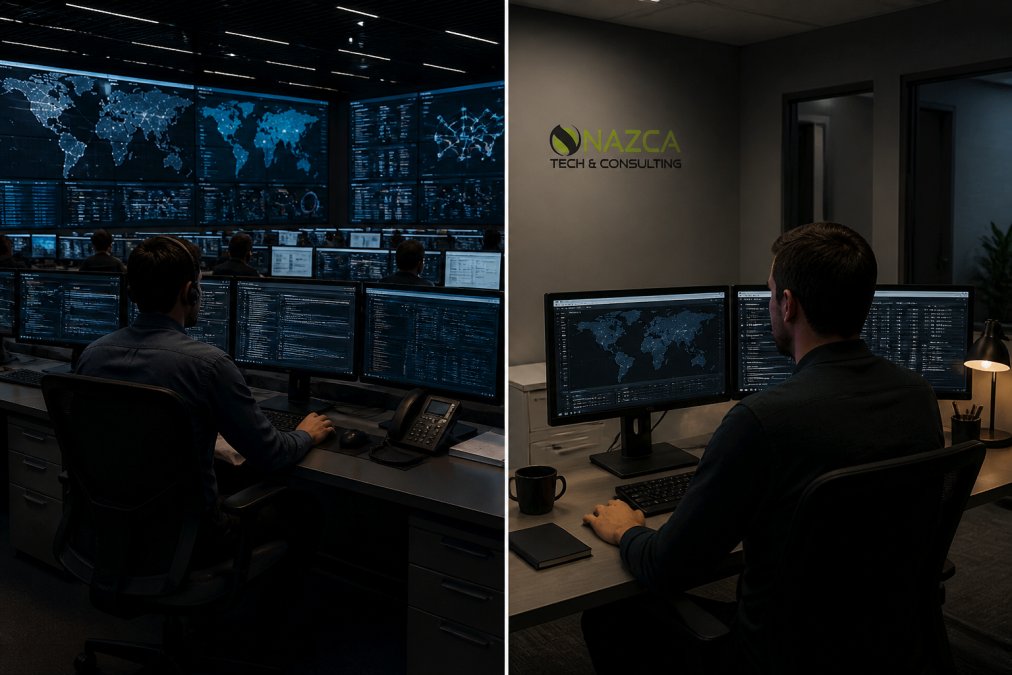
National managed security providers use advanced threat intelligence, automated response systems, and 24/7 security operations centers.
Cybersecurity Compliance and Data Protection
Compliance requirements like HIPAA, PCI-DSS, and SOC 2 demand specialized knowledge. National franchises have documented compliance frameworks applied across locations. This standardization helps but doesn't guarantee expertise at your specific location.
Help Desk Support and Remote Monitoring
Help desk support represents the daily operational touchpoint. National franchises provide standardized help desk support through shared ticketing systems. Your support ticket might be handled by any franchisee in the network or routed to corporate help desk staff.
Scalability, Business Continuity, and Infrastructure Support
Your growth trajectory determines which model serves you better long-term. Scalability isn't just about handling more users, it's about supporting infrastructure complexity as your business matures.
Growth Capacity and Resource Allocation
National franchises scale by design. They've structured operations to handle growing companies. As you expand from 50 to 200 to 500 employees, the franchise model accommodates growth through standardized processes and resource allocation protocols.
Disaster Recovery and Service Level Agreements
Service level agreements define your protection level. National franchises publish standardized SLAs, typically 99.5% uptime guarantees with defined response and resolution times. These SLAs apply across their network.
Hidden Costs and Contract Flexibility
Neither model advertises their hidden costs, but they exist. Understanding these prevents budget surprises and informs your true cost comparison.
| Factor | National Franchise | Local Provider |
|---|---|---|
| Monthly Cost (25-99 employees) | Varies | Varies |
| Response Time | Varies | Varies |
| Contract Length | 12-24 months | Month-to-month common |
| Scalability | Excellent above 200 employees | Depends on provider |
| Specialization | Standardized | Custom to industry |
| Hidden Costs | Platform fees, compliance charges | Hourly overages, travel fees |
Which Option Is Right for Your Business
The decision depends on five specific factors: company size, complexity, growth plans, compliance requirements, and service expectations.
Frequently Asked Questions
What is the main difference between CMIT Solutions and local IT support providers?
CMIT Solutions operates as a national franchise network with over 250 independently owned locations, offering enterprise-grade resources backed by national infrastructure. Local IT support providers typically operate independently or as small regional firms, emphasizing personalized service and direct relationships. CMIT Solutions provides standardized processes and access to broader technical expertise, while local providers offer flexibility and on-site responsiveness tailored to your specific business needs. For businesses needing both national scale and local accountability, the choice depends on whether you prioritize consistent brand standards or customized, relationship-driven support.
How do managed IT services pricing models differ between national franchises and local providers?
National franchises like CMIT Solutions typically use tiered subscription models based on employee count or service level. Local providers often offer flexible pricing with options for break-fix, retainer, or hybrid models, allowing negotiation based on your specific needs. National franchises provide predictable, transparent pricing aligned with their standardized service packages. Local providers may offer lower entry costs but risk surprise charges if services aren't clearly defined upfront. Request detailed quotes from both types to compare total cost of ownership, including support hours, response times, and included services.
What are the main benefits of choosing a local managed IT services provider?
Local managed IT services providers excel at rapid on-site response, personalized attention, and understanding your industry-specific needs. They can visit your office quickly for emergencies, offer flexible service customization, and build long-term relationships with your team. Local providers are often more agile in adapting to unique business requirements, such as custom software development or legacy system integration. However, they may have limited 24/7 support capacity and smaller technical expertise pools compared to national networks. For healthcare practices, legal firms, and businesses with specialized operational needs, local providers' ability to tailor solutions and provide hands-on support often justifies their selection.
Do managed security providers offer better compliance protection, national franchises or local firms?
Both national and local managed security providers can deliver HIPAA compliance, cybersecurity monitoring, and data protection, but they differ in approach. National franchises bring standardized compliance frameworks, larger security operations centers, and access to advanced threat intelligence across their network. Local providers offer specialized expertise in your industry and direct oversight of your security posture, often with faster incident response due to proximity. For HIPAA-regulated businesses like healthcare practices, verify that your provider has documented compliance training, regular security audits, and incident response protocols. Many small local firms partner with national security platforms to combine local service with enterprise-grade threat detection.
What should I prioritize when choosing between a franchise-based IT firm and a local boutique provider?
Start by evaluating your business's size, growth trajectory, and technical complexity. If you need scalable infrastructure, 24/7 support, and standardized processes as you grow, a national franchise offers consistency across multiple locations and access to specialized expertise. If you require rapid on-site response, custom software development, or industry-specific knowledge (such as healthcare IT), a local provider's flexibility and direct accountability may be more valuable. Consider your geographic footprint: national franchises work well for multi-location businesses, while local providers excel for single-site operations needing personalized service. Request service level agreement (SLA) commitments from both, compare response times and support hours, and ask for references from similar-sized businesses in your industry.