 how-to
Common Security Risks for Remote Healthcare IT Infrastructure
Last Updated: October 22, 2026
Quick Summary
The most common security risks for remote healthcare IT infrastructure are ransomware and data extortion, phishing and social engineering, weak or reused passwords, unpatched medical devices, insecure telehealth platforms, and unsecured home networks. Each risk maps to a specific control, such as immutable offline backups, multi-factor authentication, network segmentation, and VPN or zero-trust access for every clinical session.
- Sixty-one percent of healthcare leaders believe a fatal patient incident from a cyberattack is inevitable, per Omega Systems' 2026 report.
- Ransomware hit 78% of companies over the past year, with disclosed incidents projected to grow 40% by the end of 2026.
- Put connected medical devices on an isolated VLAN with deny-by-default rules and inventory each device within 30 days.
- Require phishing-resistant MFA for privileged EHR accounts and enforce encryption on every laptop and mobile device.
- Track three indicators per role: approved access path usage, managed versus unmanaged devices, and time from offboarding to revocation.
Table of Contents
- Why Remote Healthcare IT Infrastructure Is Under Attack
- 1. Ransomware and Data Extortion
- 2. Phishing and Social Engineering
- 3. Weak Passwords and Credential Theft
- 4. Medical Device Cybersecurity Gaps
- 5. Telehealth Security Risks
- 6. Remote Workforce and Home Network Exposure
- Healthcare Cybersecurity Best Practices That Close the Gaps
- Frequently Asked Questions
Why Remote Healthcare IT Infrastructure Is Under Attack
Sixty-one percent of healthcare leaders believe a fatal patient incident caused by a cyberattack on a U.S. healthcare facility is inevitable, according to Omega Systems' 2026 Healthcare IT Landscape Report. That number reframes the conversation. These are not billing headaches anymore. They are patient-safety events.
Understanding the common security risks for remote healthcare IT infrastructure starts with one uncomfortable fact: the perimeter moved, and most defenses didn't follow it. Laptops, home routers, personal phones, and connected medical devices now sit outside the controlled clinic network. Below, we break down the six risks that account for most remote-care breaches, plus the controls that actually close them.
1. Ransomware and Data Extortion
Ransomware is the top threat targeting electronic health records, medical devices, and IoT systems, per Censinet's healthcare threat overview. The mechanics matter here. Attackers encrypt patient records and then threaten to publish them, which turns a downtime problem into a HIPAA breach notification problem simultaneously.
A 2026 cloud-security statistics page reports that ransomware hit 78% of companies over the past year and projects disclosed incidents to grow 40% by the end of 2026 (SentinelOne cloud security statistics). Healthcare's version is worse than the general rate because downtime halts care.
The mitigation that matters most: immutable, tested backups kept offline from the production network, plus a documented recovery time target your practice has actually rehearsed.
2. Phishing and Social Engineering
Phishing remains the most common way attackers get inside a healthcare network. A scoping review by Y. He and colleagues identified phishing, ransomware, and distributed denial-of-service attacks among the fastest-rising healthcare cybersecurity risks, and flagged vendor dependence and misconfigured encryption as separate continuity threats (Health Care Cybersecurity Challenges and Solutions review).
Remote work sharpens the problem. A convincing fake "password reset" or "shared patient record" email lands differently on a personal laptop at 9 p.m. than it does at a monitored front desk. Credential phishing, where the attacker harvests a login rather than dropping malware, is the variant to watch: it defeats antivirus entirely because nothing malicious gets installed.
Train staff to verify sender domains and to report suspicious messages through a one-click channel. Then test them quarterly. Untested training decays within weeks.
3. Weak Passwords and Credential Theft
Weak and reused passwords remain the quiet enabler behind a large share of unauthorized access in healthcare. The failure mode is predictable: one clinician reuses a password across the EHR, a scheduling portal, and a personal email account. One breach elsewhere hands attackers a working key.
Multi-factor authentication is the single highest-value control for remote healthcare. Pair it with phishing-resistant methods, such as hardware security keys or passkeys, for anyone with elevated EHR privileges. Layer in least-privilege access controls so a compromised account reaches only the records that role legitimately needs, and enforce encryption on every laptop and mobile device that touches patient data. An unencrypted device lost in transit is a reportable breach waiting to happen.
4. Medical Device Cybersecurity Gaps
Connected medical devices carry risk that conventional endpoint security doesn't cover. A 2025 article by B. Aldosari identifies pacemakers, infusion pumps, and MRI machines as devices vulnerable to hacking or manipulation (Cybersecurity in Healthcare: New Threat to Patient Safety). The core problem is that many devices run unpatched firmware, and you often cannot install endpoint agents on them at all.
Medical device cybersecurity therefore depends on network segmentation. Put devices on their own isolated VLAN with strict access rules, inventory every connected device and its software version, and apply vendor patches on a documented schedule. If a device cannot be patched, compensate with monitoring and tighter network boundaries.
5. Telehealth Security Risks
Telehealth security risks concentrate in the endpoints and platforms that carry live patient encounters. Video visits, remote monitoring, and e-consults all move protected health information across consumer-grade networks and applications.
Three controls do most of the work. First, use only telehealth platforms that encrypt data in transit and at rest and that will sign a HIPAA business associate agreement. Second, require clinicians to join visits from managed, encrypted devices rather than personal phones. Third, authenticate patients before the session starts, not after records are already on screen. A telehealth link forwarded to the wrong inbox is a breach with a video recording attached.
6. Remote Workforce and Home Network Exposure
Home networks are the weakest link in most remote healthcare setups. Unsecured Wi-Fi and personal, unmanaged devices are among the most common remote-work security risks, and personal devices connecting to corporate systems rank as a significant exposure (SentinelOne's remote working security risks).
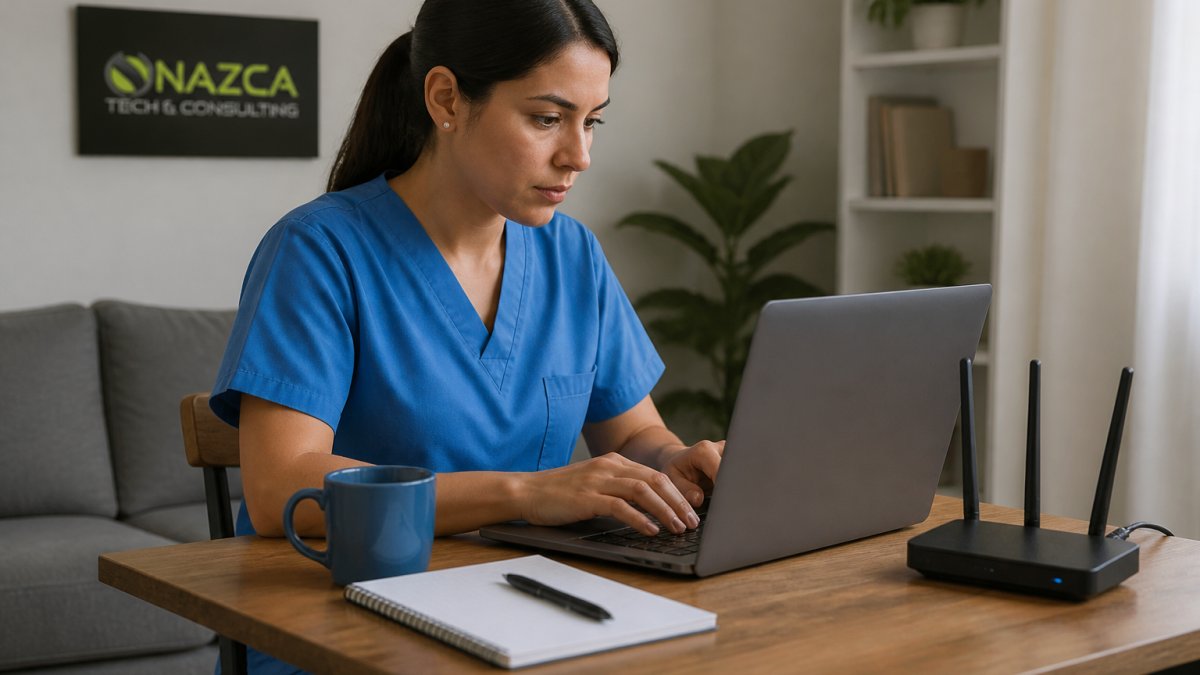
But "remote worker" is not one risk profile. The threat model changes by role, and treating every remote user the same is how gaps open. Build the model around four groups:
Clinicians. They need fast, uninterrupted access to the EHR, imaging, and e-prescribing during patient encounters. The dominant risks are session hijacking on shared home devices, shoulder-surfing during video visits, and clinicians disabling security controls to speed up login. Controls: managed laptops with full-disk encryption and endpoint detection, phishing-resistant MFA, automatic screen lock, and a privacy screen or dedicated room for telehealth. Do not let clinical urgency become the reason a control gets bypassed, pre-authenticate before the shift starts.
Administrators. Scheduling, billing, and intake staff handle high volumes of ePHI but often work on older equipment and home networks with family members sharing the same router.
Contractors. Coders, transcriptionists, and consultants frequently connect from personal devices and unmanaged networks, and their access often outlives the engagement. The dominant risks are orphaned accounts and over-broad access.
Vendors. Device manufacturers, EHR integrators, and IT support firms need remote access to clinical systems, which makes them a preferred entry point for attackers.
Across all four groups, the home environment itself is the shared variable. Household members, guest devices, and consumer routers with default admin passwords sit on the same network as clinical sessions. Practical mitigations: require a VPN or zero-trust access gateway for any connection to clinical systems, issue managed laptops with full-disk encryption and endpoint security, and separate work traffic from the household network where possible, a dedicated work SSID or, better, a cellular hotspot for clinical sessions.
Then monitor what actually connects.
Healthcare Cybersecurity Best Practices That Close the Gaps
The controls that matter most for remote healthcare map directly to the risks above. Use this as a working checklist, but treat the right-hand column as a measurement target, not a slogan:
| Risk | Primary Control | Measurable Target |
|---|---|---|
| Ransomware | Immutable offline backups | Restore tested quarterly; documented recovery time objective met in the drill |
| Phishing | Quarterly simulation training | Report rate above 80%; one-click reporting used on every simulated lure |
| Credential theft | MFA plus least privilege | 100% MFA coverage on remote access; hardware keys or passkeys for privileged accounts |
| Medical devices | Network segmentation | Device inventory current within 30 days; isolated VLANs with deny-by-default rules |
| Telehealth | Encrypted, BAA-signed platforms | Managed devices only; patient identity verified before the session opens |
| Remote workforce | VPN or zero-trust access | Every clinical session through the approved path; patch latency under 14 days |
Map controls to obligations, not the other way around. HIPAA's Security Rule requires a risk assessment and documented administrative, physical, and technical safeguards for electronic protected health information. Remote infrastructure touches all three. The technical safeguards most often cited in remote-work findings are access control, audit controls, integrity, person or entity authentication, and transmission security, which in practice means unique user IDs, MFA, encryption in transit, and logged access to ePHI. The administrative side is where practices slip: a documented risk analysis that actually names remote access paths, workforce training records, and sanction policies for staff who bypass controls. Compliance is the floor, not the goal, a signed BAA and a completed risk assessment do not reduce risk by themselves. The measurable targets in the table do.
Incident response has to work when the clinic is remote. A plan written for a server room fails when the compromised asset is a clinician's laptop on a home network. Build the remote-care version around four moves:
- Contain without cutting off care. Isolate the endpoint at the network layer, disable the VPN session or quarantine the device through endpoint management, rather than disabling the user's account, which can lock a clinician out of the EHR mid-shift. Keep a break-glass account path for continuity.
- Preserve clinical access. Have a documented downtime procedure for scheduling, e-prescribing, and records lookup that does not depend on the compromised device. Staff should know where the fallback is before they need it.
- Scope the blast radius. Pull authentication logs, VPN logs, and endpoint telemetry to determine which systems the account or device reached. Remote sessions leave a trail; use it.
- Meet notification deadlines. HIPAA breach notification timelines run from discovery, and a lost unencrypted laptop is presumed a breach unless you can demonstrate encryption. Encryption and asset inventory are what make that determination fast.
This is where working with a partner trained in HIPAA compliance and ePHI security protocols pays off. Nazca Tech has spent over 21 years building and defending healthcare IT infrastructure, with technicians trained specifically in HIPAA compliance and ePHI security protocols. Our hybrid support model combines remote assistance with on-site response, backed by rapid response times: one hour for remote support and three hours for on-site emergencies. For practices that need a documented incident response plan and continuous security monitoring rather than a break-fix relationship, that structure matters.
Frequently Asked Questions
What are the most common security risks in remote healthcare IT infrastructure?
The biggest risks are ransomware, phishing and social engineering, weak or stolen credentials, unpatched software, and unsecured home networks. Connected medical devices and telehealth tools add another layer, since pacemakers, infusion pumps, and MRI machines can be targeted or manipulated. A 2026 report found 61% of healthcare leaders think a fatal patient incident from a cyberattack is inevitable, and ransomware already hits 78% of companies. Each risk ties back to remote healthcare infrastructure that extends beyond the clinic walls.
How can providers reduce telehealth security risks?
Start with multi-factor authentication on every telehealth platform and require encrypted video and messaging tools. Limit access to protected health information using least privilege, so clinicians see only the records they need. Keep patient-facing apps patched and test them before rollout. Train staff to spot phishing that targets video-visit links, and log every remote session so you can audit access later. These steps address the most common telehealth security risks without slowing down care.
What security risks do connected medical devices create?
Connected devices like pacemakers, infusion pumps, and MRI machines run on software that may go unpatched for years, and many ship with default passwords. A 2025 review named these devices as vulnerable to hacking or manipulation. Because they sit on the same networks as electronic health records, a compromised device can become a path to patient data. Medical device cybersecurity requires inventory tracking, network segmentation, and a patch schedule agreed on with vendors.
How should healthcare IT teams respond to a ransomware attack?
A healthcare incident response plan should start with isolating affected systems, then notifying leadership and your HIPAA privacy officer. Restore from offline backups you have tested, not from the same network the attackers reached. Document everything, because breach notification rules may apply. A 2026 projection expects ransomware incidents to grow 40% by year-end, so rehearse the plan before you need it. Remote sites need their own contact list and recovery steps.